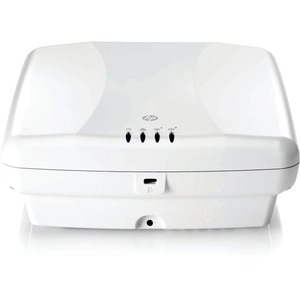
HPE 560 802.11ac Dual Radio Access Point Series bring 1.3 GbE performance, faster application processing, and increased range to 802.11 clients. Ideal for dense client environments and high bandwidth applications, the access points can be powered by Power over Ethernet (PoE) and offer full compatibility with legacy 802.11 clients and existing HP wireless controllers.
The access points can be used in managed as well as autonomous mode without a controller. The access points provide Radio Frequency spectrum analysis with detection and classification of non-IEEE 802.11 interference and has the ability to automatically avoid interference. Wireless security is comprehensive when operating with a controller; with integrated wireless IDS/IPS, support for internal and external authentication, authorization, and accounting (AAA) servers; built-in stateful firewall; per-user VLAN mapping; and authentication.
Note:
- The full product specifications below are from the manufacturer and may contain information related to other package quantities that will not apply to the product that you are reviewing. Please confirm the actual content and/or package quantity from the main product specifications page.
- These specifications may represent the entire product series/model/line to which this product belongs with specific configuration differences between the individual products stated.
- These specifications may have been copied from the same product in other region/country in which case there might be minor differences in region-specific data such as Input Voltage, Terms of Warranty etc.
I/O ports and slots 1 RJ-45 autosensing 10/100/1000 port (IEEE 802.3 Type 10BASE-T, IEEE 802.3u Type 100BASE-TX, IEEE 802.3ab Type 1000BASE-T); Duplex: 10BASE-T/100BASE-TX: half or full; 1000BASE-T: full only
Additional ports and slots 1 RJ-45 serial console port
AP characteristics
Radios (built-in) 802.11b/g/n, a/n/ac
Radio operation modes Client access, Local mesh, Packet capture
AP operation modes Autonomous and controlled
Wi-Fi Alliance Certification a/b/g/n/ac Wi-Fi Certified
Antenna (3) 5 dBi 2.4 GHz and (3) 7 dBi 5 GHz
Number of internal antennas 6
Physical characteristics
Dimensions 8(w) x 6.75(d) x 2.62(h) in (20.32 x 17.15 x 6.65 cm)
Weight 2.25 lb (1.02 kg) mounting bracket
Memory and processor Dual core @ 800 MHz, 128 MB flash, 256 MB SDRAM
Mounting and enclosure Indoor, plenum rated; Includes two ceiling mounting clips
Environment
Operating temperature 32°F to 122°F (0°C to 50°C)
Operating relative humidity 5% to 95%, noncondensing
Non-operating/ Storage temperature -40°F to 158°F (-40°C to 70°C)
Non-operating/Storage relative humidity 5% to 95%, noncondensing
Altitude up to 10,000 ft (3 km)
Electrical characteristics
Description IEEE 802.3af/802.3at PoE compliant for Gigabit Ethernet
Maximum power rating 14 W
PoE power 13 W PoE+
Notes With 802.3af PoE, the 2.4GHz radio will operate in 2x2:2 MIMO mode, < 12.9watts; With 802.3at PoE+, both radios will operate in 3x3:3 MIMO mode, < 14watts
Frequency band and Operating channels
Americas 2.412 - 2.462 GHz (1 - 11 channels)
5.180 - 5.320 GHz (36 - 64 channels)
5.500 - 5.700 GHz (100 - 144 (excluding 5600-5670 MHz) channels)
5.745 - 5.825 GHz (149 - 165 channels)
European Union 2.412 - 2.472 GHz (1 - 13 channels)
5.180 - 5.320 GHz (36 - 64 channels)
5.500 - 5.700 GHz (100 - 140 (excluding 5600-5650 MHz) channels)
Rest of World (Actual
channels designated by
2.412 - 2.472 GHz (1 - 13 channels)
5.180 - 5.320 GHz (36 - 64 channels)
selecting country in UI) 5.500 - 5.700 GHz (100 - 144 channels)
5.745 - 5.825 GHz (149 - 165 channels)
Taiwan 2.412 - 2.462 GHz (1 - 11 channels)
5.280 - 5.320 GHz (56 - 64 channels)
5.500 - 5.700 GHz (100 - 144 (excluding 5600-5670 MHz) channels)
5.745 - 5.825 GHz (149 - 165 channels)
Japan 2.412 - 2.472 GHz (1 - 13 channels)
5.180 - 5.320 GHz (36 - 64 channels)
5.500 - 5.700 GHz (100 - 140 channels)
Israel 2.412 - 2.472 GHz (1 - 13 channels)
5.180 - 5.320 GHz (36 - 64 channels)
Radio FCC Part 15.247; FCC Part 15.407 (US); RSS-210 (Canada); EN 300 328; ARIB STD-T66; IDA Registration (Singapore); RCR STD-33; ARIB STD-T71 (Japan); EN 301 893 (EU); KCC approval (Korea)
Safety UL 2043; UL 60950-1; IEC 60950-1; EN 60950-1; CAN/CSA-C22.2 No. 60950-1
Medical EN60601-1-2
RF Exposure FCC Bulletin OET-65C; RSS-102; CFR 47, Part 2, Subpart J; ANSI/IEEE C95.1 (99); Ministry of Health Safety Code 6; Australian Radiation Protection Std.
Features Dual radio: IEEE 802.11a/n/ac for very high-throughput applications and IEEE 802.11b/g/n for legacy
support and high-speed applications
- Integrated antennas for both IEEE radios, supporting three spatial streams and 3x3 MIMO
- Six embedded antennas
- Both radios operate at full functionality with IEEE 802.3at PoE+ power
- The 2.4GHz 802.11b/g/n radio operates at 2x2:2 mode with 802.3af power, while the 5GHz 802.11ac
Revise Series Specs (Web only)
1 RJ-45 autosensing 10/100/1000 port
802.11b/g/n, a/n/ac
IEEE 802.11 a/b/g/n/ac
(3) 5 dBi 2.4 GHz and (3) 7 dBi 5 GHz = 6
Emissions 55022 Class B; EN 301 489-1; EN 301 489-17; ICES-003 Class B; FCC Part 15, Class B
Notes
Supported data rates
• 802.11b: 1, 2, 5.5, 11 Mbps
• 802.11a/g: 6, 9, 12, 18, 24, 36, 48, 54 Mbps
• 802.11n: 6.5 to 450 Mbps (MCS0 to MCS23, 1 to 3 spatial streams)
• 802.11ac: 6.5 Mbps to 1.3Gbps (MCS0 to MCS9, 1 to 3 spatial streams)
• 802.11n high-throughput (HT) 20/40
• 802.11ac very high throughput (VHT) 20/40/80
• 802.11n/ac packet aggregation A-MPDU and A-MSDU
The HPE 560 access point power information listed includes the embedded antenna. The software will automatically adjust the maximum power levels based on the country of operation.
Three spatial stream AP, supporting 450 Mb/s on the 2.4GHz band and 1.3GHz on the 5GHz band.
Maximum transmit power varies by country.
Regulatory model number for the HPE 560 Access Point - MRLBB-1304
• 802.11n Radio - MRLBB-1003
• 802.11ac Radio - MRLBB-1303
Services Refer to the Hewlett Packard Enterprise website at http://www.hpe.com/networking/services for details on the service-level descriptions and product numbers. For details about services and response